Electric Particles
In the Electric Particles lab, students investigate traditional, oppositely charged electric particles. These reflect real life particles exactly, following Coulomb's law. The students are given access to quantitative tools to measure the relationship between charge, distance, and force. The tools available are: a force meter, which measures force in the direction of orientation; a measuring tape, which measures the distance between two set points; and a charge tool, which allows the manipulation of charge forces on positive or negative particles respectively. As well, students are also allowed to pause time at any point to arrange the lab without the worry of electric forces.
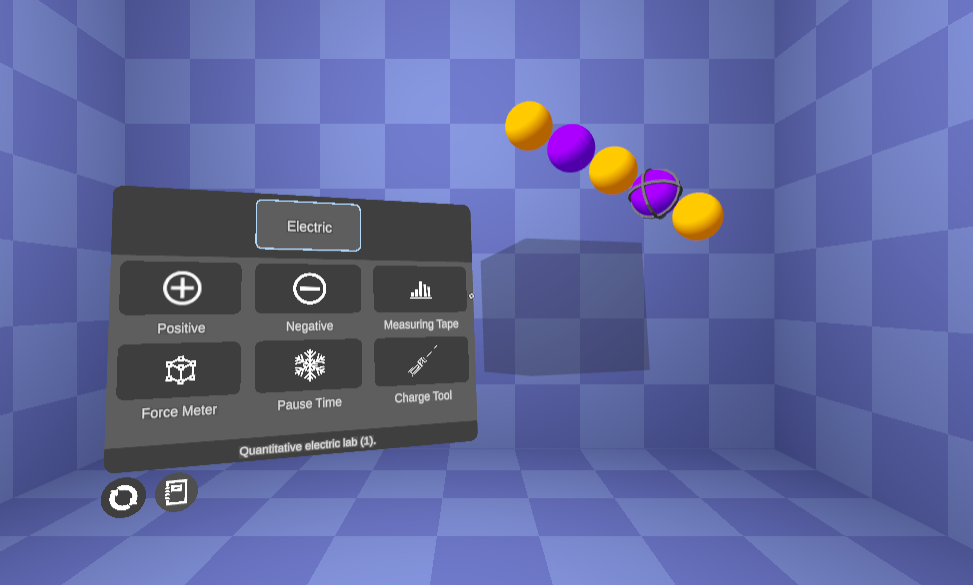
An image of electric particles placed in sequence next to a menu (1/4).
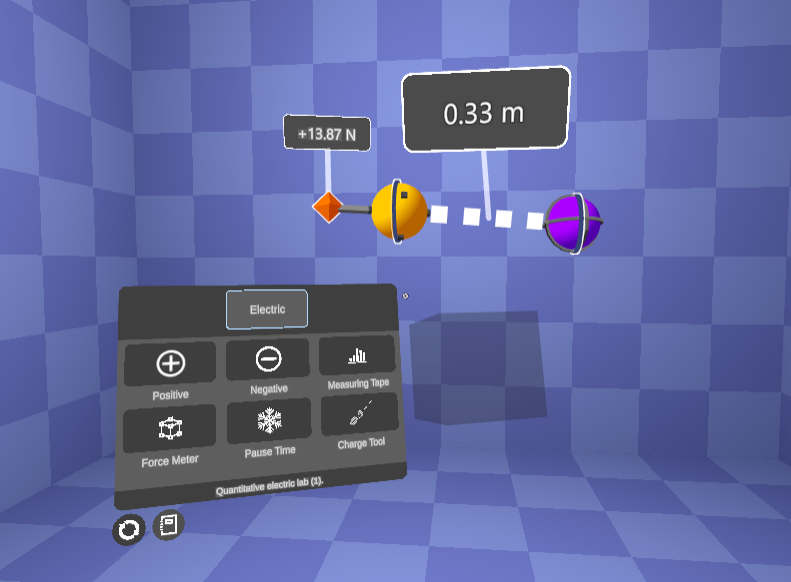
An image of lab setup with two charged particles and a force meter (2/4).
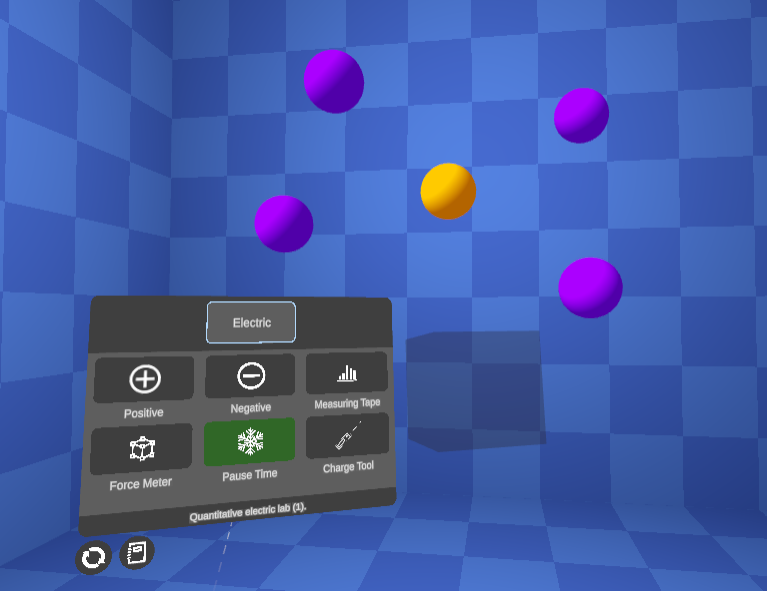
An image of five charged particles in space while time is paused (3/4).
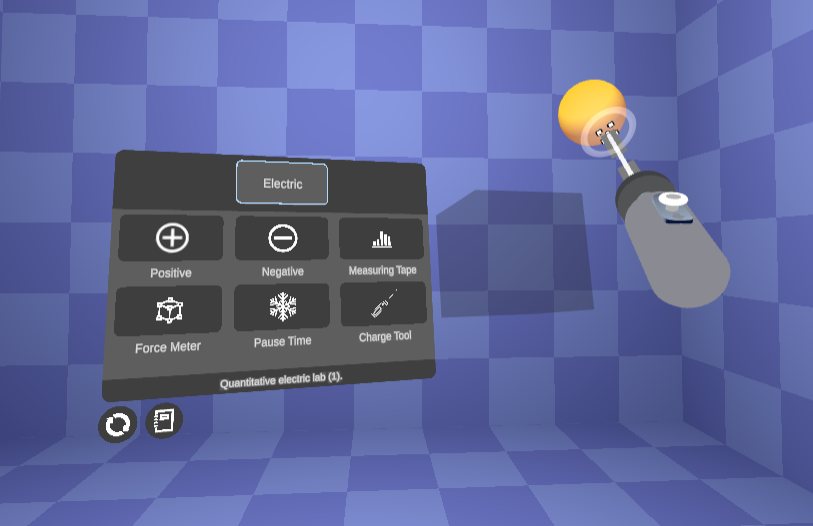
An image of charge tool being used to modify the charge on a particle (4/4).
Exotic Matter
In the Exotic Matter lab, students generate particles with fictitious interactions. Their goal is to develop a mathematical model to describe the unique forces exerted by the particles. There are currently five variations of the exotic matter lab which have intermolecular forces varying by: charge, distance, type (enumerated), velocity, and time.
The students can only use basic tools to gather data. The only correct answers are the ones the students can make the best case for based on the data they collect. After making their case, their research proposals are either accepted or required to be redone. Once accepted, students have access to a virtual budget, allowing them to buy new and more complex tools to determine the nature of their particles.
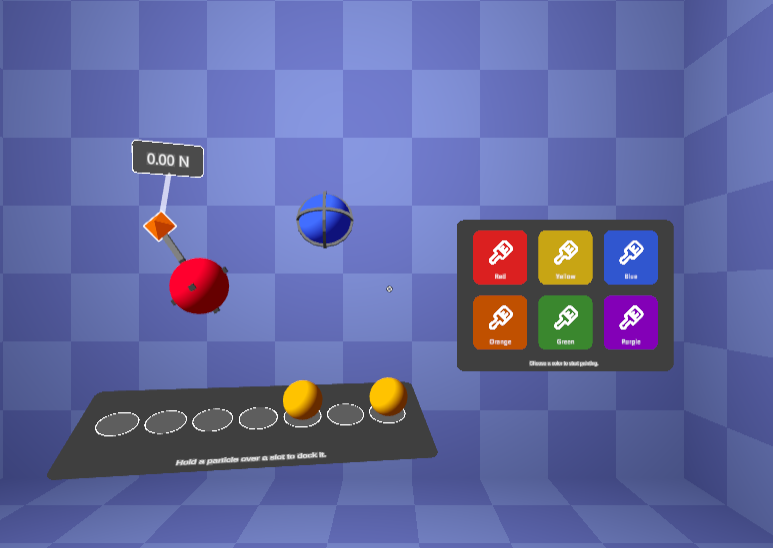
An image of lab setup with two painted particles and a force meter reading zero force (1/2).
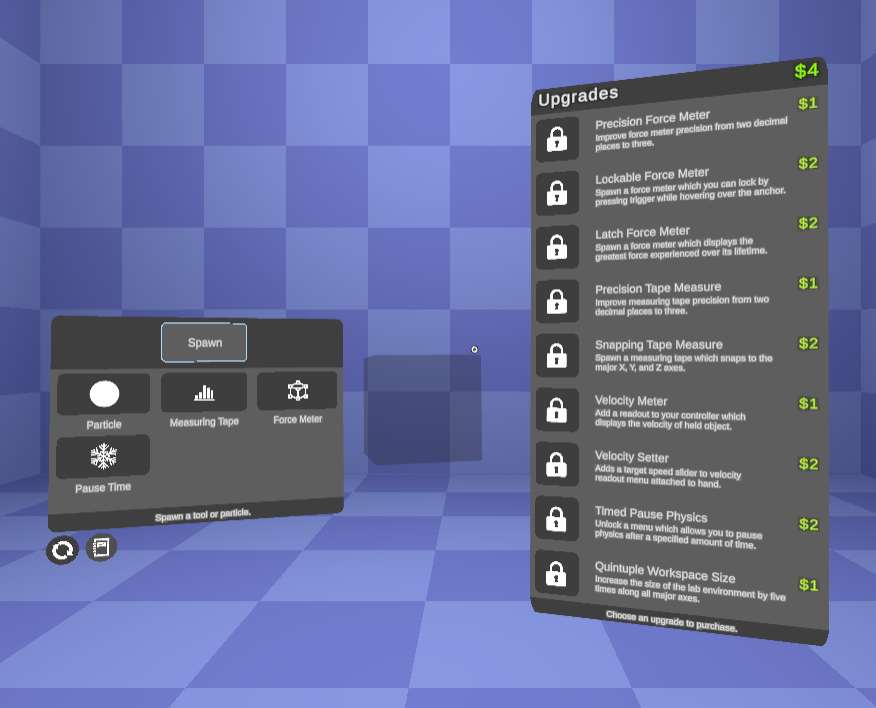
An image of lab menus, including the budget menu which allows the purchase of various tools (2/2).
Charge Distribution
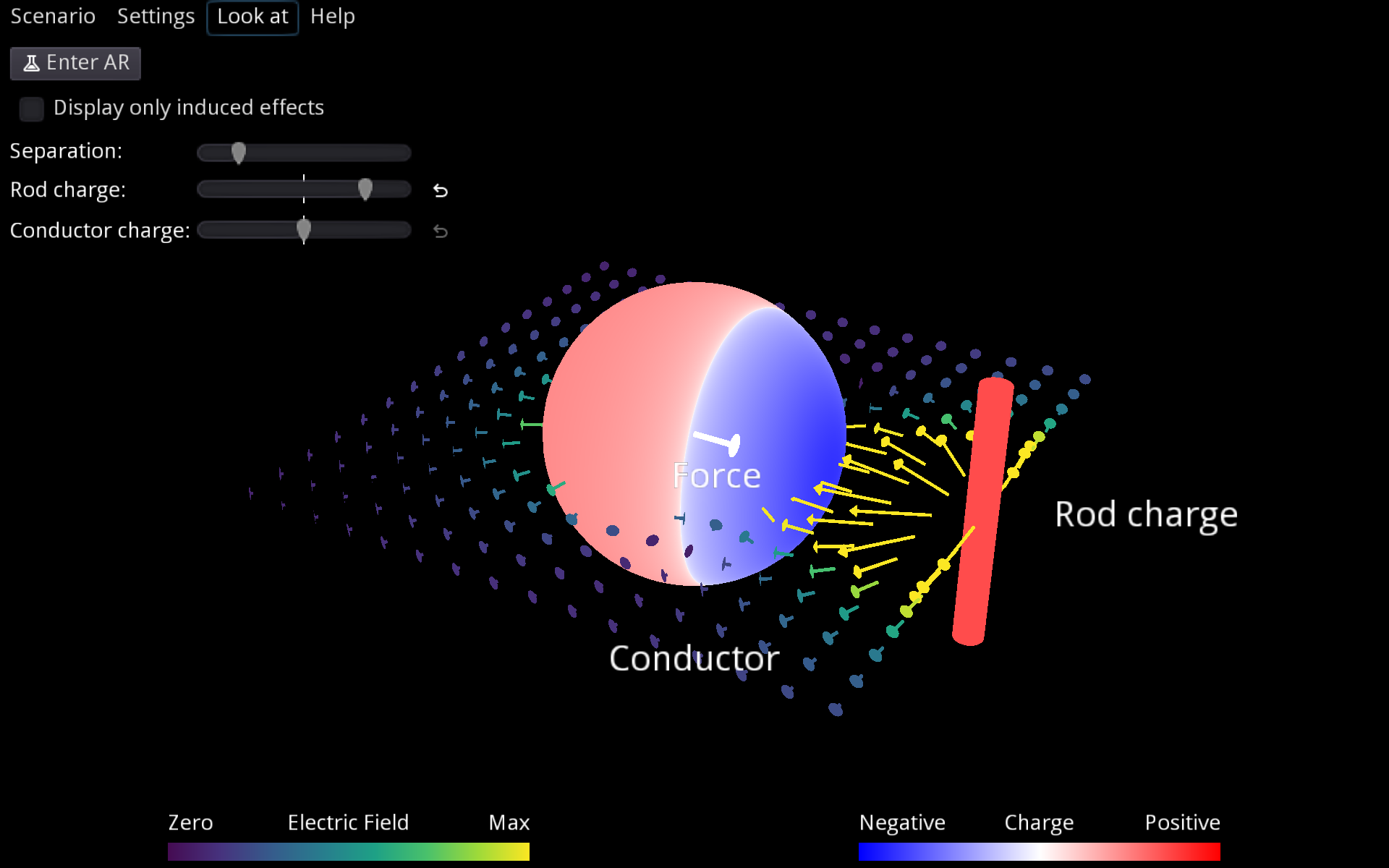
An image of the charge distribution simulation web page (1/1).
Decay Particle
In the Decay Particle lab, students must investigate the mechanisms of beta decay using analyses derived from the Lorentz force. In the simulation, students observe the unstable “Omegon" spontaneously decay into three daughter particles. One of these daughters is small and neutral, hence undetectable. Students observe the path these daughters take after decay in a constant magnetic field.
After observing these paths, the user can access another simulation to measure the charges of the daughter particles. For these purposes, the user has access to an ion trap, which catches the particles before they leave the testing environment. The user can then use methods similar to the electric lab to find the charges, completing the final piece of the puzzle to determine the initial mass (and identity) of the omegon.
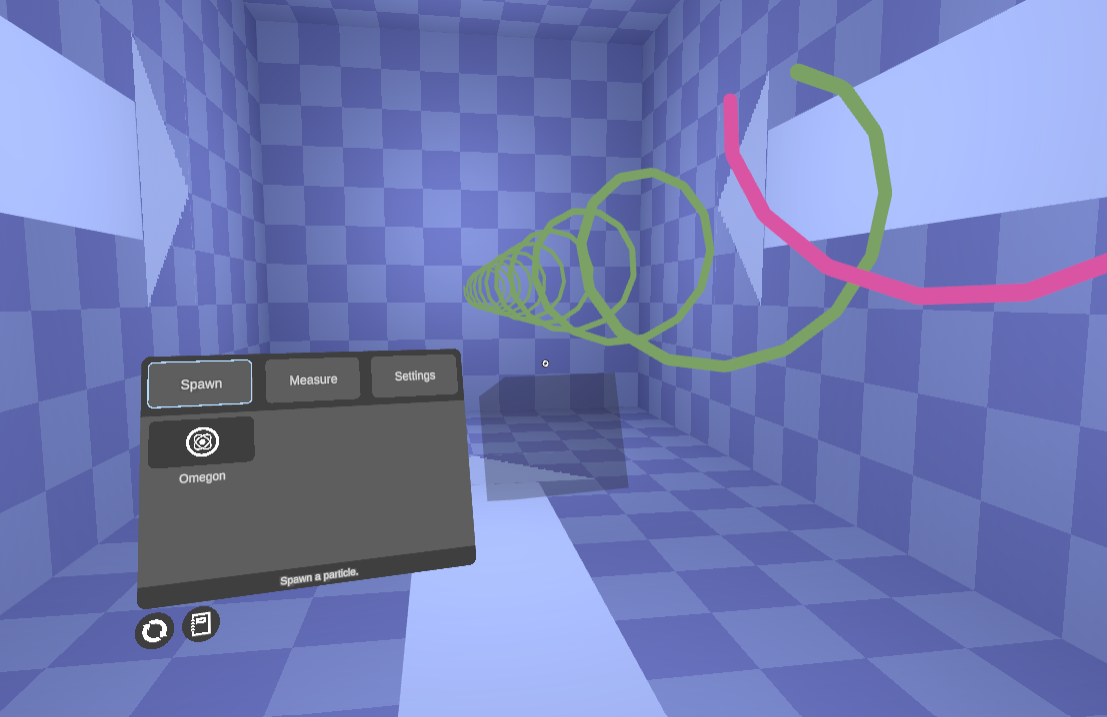
An image of helices in the simulation space showing the path daughter particles take (1/3).
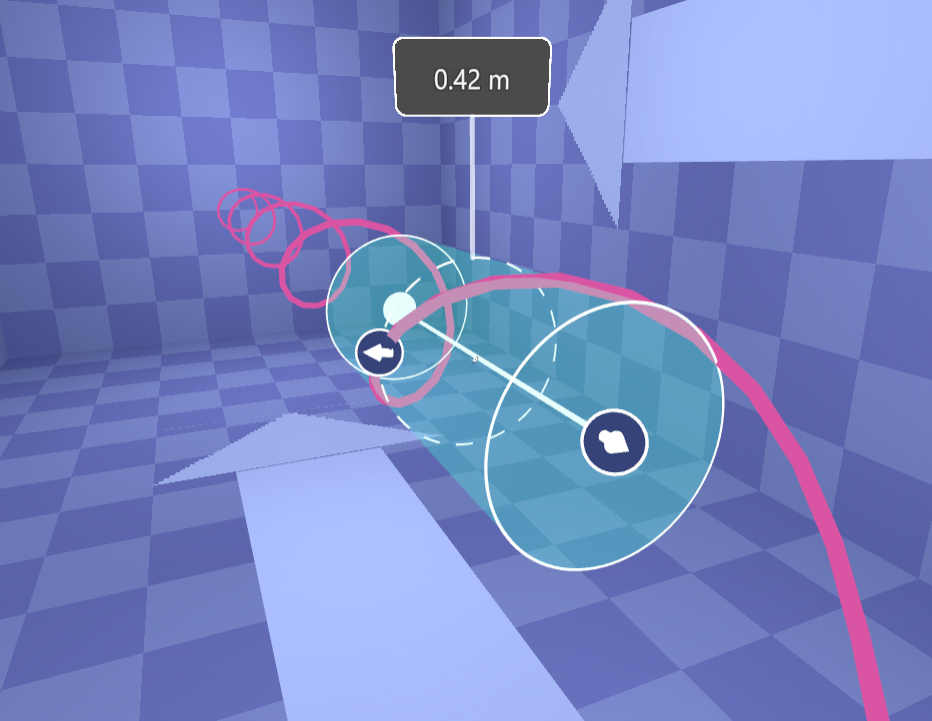
An image of a measuring tool imposed onto a helix to find the radius of the path taken (2/3).

An image of a daughter particle trapped in an ion trap (3/3).